
Start point: High Camp / Camp 3 (c. 6,000m)
High point: Summit (6,962m) and return to Camp 3
Getting Ready
Sleeping was not easy. We’d been warned to bring everything we needed inside the tent to prevent it from freezing or blowing away, so the tent was even more cramped than usual. Our tent was at a slight slope, so my tentmate had placed a bag between us to prevent him rolling down on top of me. And despite the tent being weighed down by heavy rocks, two medium to large men, and a big load their gear, the tent shook and lifted so much in the wind that I would not have been surprised had it either blown away or been torn in two.
I managed to get a little sleep, but not a lot. I woke often and dozed for most of the night. Our tent was situated beside the guides’ tent from another team. We could hear their stove burning for what seemed like most or all of the night – I can’t blame them, as like us, they would need to have hot water available for teas, coffees and soups before we set off. Through the heavy gusts of wind, the constant drone and hiss of the boiler was quite reassuring. I could also hear various people shifting around outside.
We received our first wake up call at 3.30 a.m., an hour earlier than expected, but, at least in our tent, we were already awake. We were told hot and cold water would be brought to each tent at 4.30 a.m. and not to leave the tents before everyone was ready to depart. Standing around in the cold was a bad idea, no matter how cramped and uncomfortable the tents were. The wind outside sounded incredibly strong. As soon as we got the call, I started pulling on softshell pants over my wool leggings, a micro down layer over my wool top, and liner socks inside thick woolen socks and them inside the foam liners for my boots. Then I began preparing my snacks, medicines and spare layers for packing into my rucksack. Somehow that took me 30 minutes while my tentmate still lay dozing in his sleeping bag. When he saw me at 4 a.m.: eager, excited, and almost ready to go, he asked me “What are we supposed to do between now and 5?”. I looked at him, admitted I had no idea, and lay back down to doze again.
At 4.30 we ate some of our lemon cake. I liked it. Nobody else did. Then we made some soup for the climb (which we both forgot about until hours later). Our plans changed a little and we were told that despite the noise, the weather outside was not as terrible as we had expected. We were to gather outside the tents at 5.15 to prepare ourselves for the 5.30 departure. My tentmate asked permission to leave the tent to go the loos – he came back with all his vital bits and pieces in tact (or so he said), so I figured the risk of frostbite must not be as severe as we’d feared.
There’s only so much preparation two grown men can do in a tiny cramped tent. At 5.10 I left him to the privacy of the tent and went out into the wind to put on the final layers, lace up my boots and pack my bag. When I popped my head back in 5 minutes later to tell him it was time to go, he was relaxing on the bed in his socks, checking his phone. At 6,000m above sea level, in the middle of the Andes, and 50km from the nearest signal, he was checking his phone. I wonder if he takes classes in being that chilled, (in which case, sign me up). Maybe he just takes Valium, (n which case, sign me up).
It was cold and windy outside, but nowhere near as bad as it sounded from inside the tent. We gathered together and sang ‘Happy Birthday’ to the vet. It was a touching, heartfelt moment where everyone felt strengthened and warmed by the inclusion in the team. Then some plonker started singing ‘why was she born so beautiful… ” and so on, and on, and on. (there’s always one.)
Then we started faffing. Faffing is an exercise which can only happen while a large group of people are waiting to go somewhere together. It is an accumulation of all those quick, short, but important actions that you put off until the last minute as you think they’ll take no time at all. Faffing is an activity which is only undertaken by other people – one never recognises one’s own faffing except in terms of “I’m just fixing the straps on my bag”; “I’m just tying my boots”, “I’m just adjusting my poles”. It’s all faffing and it’s bloody annoying for everybody else, no matter how good the reasons. We faffed for a good ten minutes, while fingers and toes got very very cold. This was a bad thing. We’d been warned that letting your toes get cold at the beginning could mean they take hours to warm up. That was right: I was curling my toes in my boots for at least three or four hours after we started walking and it was five or six hours before I stopped noticing them. I’m glad to say I stopped noticing because they warmed up, not because they fell off.
Just before we left camp, our IT Guy pulled out. He did it with no fussing and no faffing. He just told us he was not feeling well enough to do it, swapped his straight walking poles for my bent and battered ones and walked back to his tent. As nervous as we all were before starting, It takes a lot of guts to recognise and admit when you’re not feeling strong enough to even start. I don’t know if I would have been brave enough to do that. By pulling out early, before we even started, he took a hit for the team. If he had tried to start and pulled out later, one of our guides would have had to leave us to bring him down safely. By giving me his walking poles, he also took a hit for me – (literally, as one of my poles snapped underneath him later that day).
From Camp to Independencia Hut
Some of the other teams from the camp had started ahead of us, so we could see their headtorches lighting the way up to White Rocks. The torches were all pointing in different directions and it looked like people were just walking around randomly, but they were actually following a path that zigzagged it’s way up the slope above high camp. Our groups spread out as we proceeded up the zig zags. We couldn’t see much more than headtorches in the distance, so it was difficult to know where the different members of the team were. The guides at the front and the back had radios and were keeping each other informed of how much the group was drifting apart.
We couldn’t take any breaks on this first piece as it was still dark and too cold and I don’t remember a lot happening. At one point, we overheard the guides mentioning on the radio that two more of the team had turned back, but I think I knew who until we reached White Rocks two hours after we started. As we approached the top of the ridge from the west, the sun was coming up on the other side. It cast a perfect triangular shadow of Aconcagua on the mountains and clouds behind and beneath us.
We stopped at White Rock just long enough to enjoy the sun for a moment, allow the team to regroup and to have some food and water. The doc handed me half a chocolate biscuit he wasn’t able to finish. It was both frozen solid and very dry. I tried to eat some, but I couldn’t finish it either. I feel bad – he had carried that biscuit for two weeks and I barely managed a nibble.
After White Rocks, the mood improved a lot as we the sunlight warmed us all up. My toes were still freezing, but I was getting warm on top, so we had a mini break to remove layers. We were warned we’d need them again soon. Already the group was beginning to spread out again and by the time we got to Independencia Hut a few hours later, another one of the team had turned back. Our guide Bruno had also gone to make sure everyone got back down safely.
Independencia Hut sounds is at about 6,400m. We’d been told that the summit day was effectively split into three sections: the climb to Independencia Hut; crossing the Canaleta; and the final climb. So the hut marked a third of the climb done. The hut looks like more like a big dog kennel that something meant for humans. I understand it’s intended as a rescue shelter, but a lot of the planks are missing, so if you really needed the shelter, I’m not sure how good it would be. At the hut, I remember I ate some jelly snakes. I was quite tired. Everyone was tired. Packie could see that we were tired and glad of the short break, so he told us encouragingly “Now it get’s difficult!”. Then he told us to put back on any layers we’d taken off – we were going to need them.
Crossing the Canaleta to the Cave
At some point during the trip, someone had read about Summit Day that once you’ve reached X, you’ve done the worst and you’re more than likely going to summit. At Independencia Hut, we thought we were at that point. We were wrong. We were very wrong.
The Canaleta is a long exposed traverse. There’s a steep slope up on your left and a steep slope down on your right. The path doesn’t climb very much and the path is quite good. But the wind. Oh holy god, the fecking wind…
Not only did we have to put back any spare layers we had taken off, we had to cover any exposed skin. The wind is so fast and cold, it could cause frostbite very quickly. And we were lucky enough to have good weather. We all pulled balaclavas and hats down to meet the goggles and pulled buffs up to cover our cheeks and noses. We checked each other to make sure everything was covered and once everyone was ready, we climbed through a small snow field to cross another ridge onto the Canaleta itself.
The wind came from our right and it was freezing. We couldn’t hear anything except the wind against our hoods. Within a minute my buff was stiff and difficult to breathe through. The wind had frozen my breath as it passed through the buff. Wearing big mitts and still in the wind, there wasn’t much I could do. Adjusting the buff would mean exposing my nose, which wasn’t a good idea. The icy wind had already done a great job of unblocking my sinuses – I was afraid that exposing my nose could possibly have unblocked my nose in a very permanent manner.
The canaleta path is long and relatively straight, so we could see the other teams moving slowly ahead of us. The nearest team were sheltering behind a large finger of rock that poked straight up out off the scree beside the path. As we came nearer to them, I kept willing them to move on so we could take their shelter. They moved just as we reached them. We stopped for a minute or two – nine of us huddling behind the finger. I slid the buff around my face so I’d have a cleaner drier warmer piece to breath through, at least for a minute. As I’d been wearing the same buff for two weeks, none of it was particularly clean.
As we prepared to move off, Packie saw a guide and a client coming back towards. He recognised that somebody in one of the other teams was turning back and reminded us that if we didn’t feel like we could go on, now was the time to mention it, when we could send more of us down without losing one of our two remaining local guides. He pointed out that once we reached the top, if we reached the top, we’d still need to make it back down again, under our own steam. If anybody felt they didn’t have enough in the tank to do that, now was the time to say so. Nobody said anything. I don’t know what anybody else was thinking. I was thinking ‘oh crap, I’m knackered and freezing’. I still said nothing and we all pressed on.
At the end of the Canelata, the path slopes steeply up. It widens out a bit and the scree becomes loose and unstable. It felt like every two or three steps we took, we’d slide back down again almost as far. We were already tired and our legs were aching, so the extra steps felt painfully frustrating. Using the IT Guys walking poles to climb the slope was beginning to hurt my arms. Every time we took a break, I tried to adjust them down to my size. After three or four attempts, I realised I was twisting them the wrong way. They were very clearly marked to show which was to twist them. Whether due to altitude, exhaustion or just regular stupidity, I was looking at the little arrow showing which way to turn and twisting them backwards, making them tighter each time we stopped.
There is an overhang at the top of the Canaleta where there is some shelter from the wind and sun. It’s called the Cave and marks the beginning of the last section. We could see people resting in the cave as we climbed the slope towards them. They were less than 50m away from us and we could see their faces quite clearly. It felt like we should reach them in a matter of minutes, but it took an hour to climb that slope. At 6,600m, every step left us out of breath and the scree kept on shifting back underneath us. It was difficult to keep going.
When we finally got there, luckily we were able to take a long rest at the cave. We were told there would now be no need for our crampons, so we gratefully unpacked them from our bags. That was out last piece of technical equipment – none of it needed. Our bags were almost empty, but they were still an effort to carry. We could see that some other teams had left their bags in the cave rather than carry them to summit. We asked could we do the same. No. In retrospect, as my bag had my spare water and my flask of soup, leaving it would have been a bad idea.
I don’t like littering, but as I sat and ate some sweets in the cave, the sweetwrapper was blown out of my hand by the wind. I didn’t even reach out my hand to try and catch it. I just watched it fly away and said “bugger”. Packie immediately jumped up from where he was sitting, skipped lightly over the rocks and grabbed the wrapper before it could get too far. He handed it back to me with a gentle reprimand, “be more careful, guys”. I felt like a right knob – not for the first time.
From the Cave to the Summit
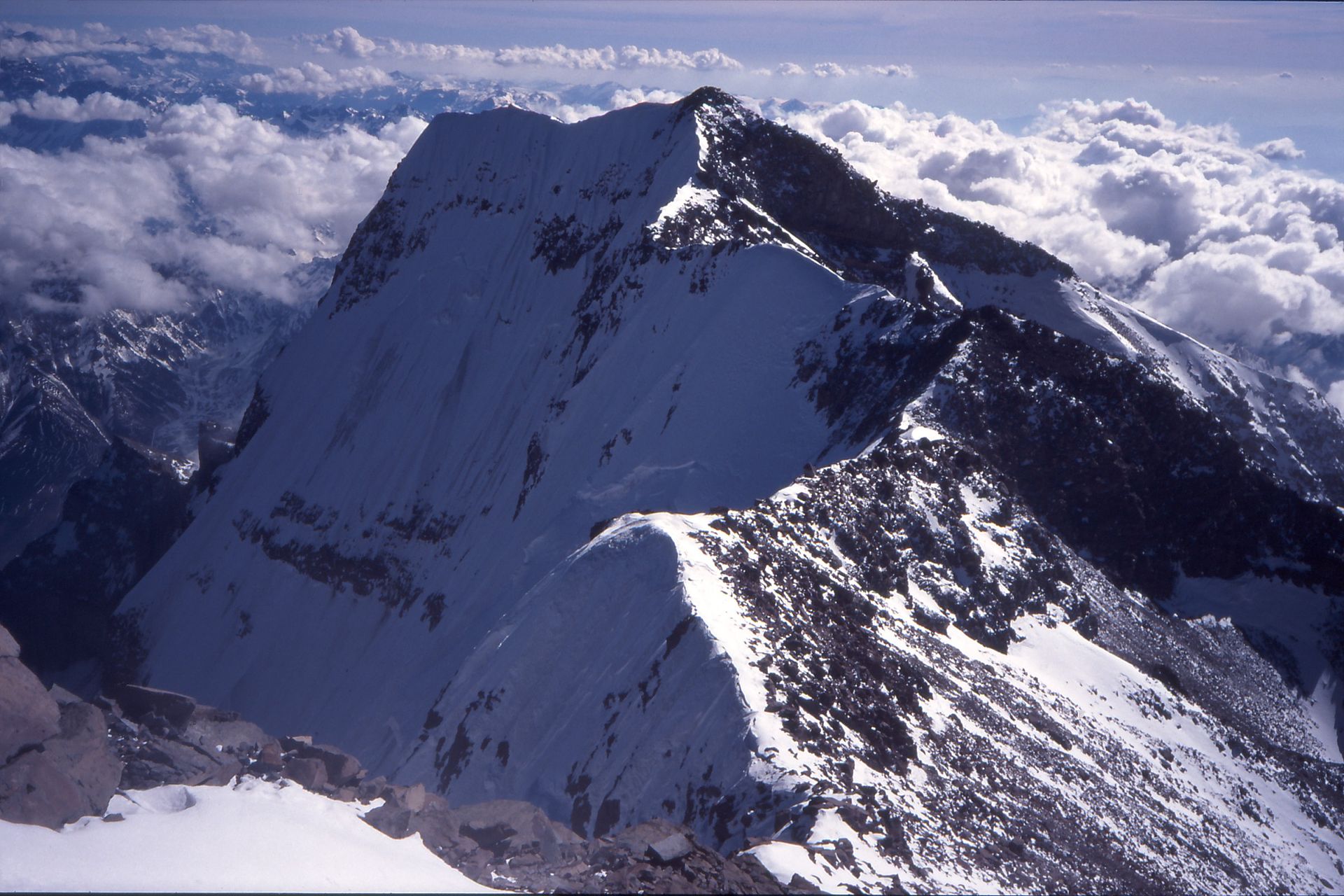
We could see the edge of summit from where we sat cave. It really didn’t look far away – maybe 500m away across a deep depression and about 300m above us. In Ireland, this would be a small hill – maybe a 45 minute stroll. We could see clearly see people on the ridge between the summit and us, but they all looked like they were stopped or barely moving at all. We were told it was another two and a half or three hours to get up there.
Again, before we left the cave, we were reminded again that if we didn’t feel we could make it both up to the top and back down again all the way to camp, now was the time to pull out. “It’s all about honesty”, he said, “honesty with yourself and honesty with us”. I remember looking around the shelter of the cave – the shade, the shelter from the wind; and the comfortable rocks to sit on. Then I looked back at the loose scree and rocks we had to continue climbing to reach the ridge. I was very very tempted to stay.
Every time Packie mentioned pulling out or turning back if you don’t feel strong enough, I thought he was talking to me. I thought he knew how bad I felt and that he was giving me an opportunity to do the right thing and opt out. A very strong part of me wanted someone else to make that decision for me. I wanted someone to tell me I wasn’t strong enough. I asked a few people how they were feeling – hoping that when they’d ask me the same thing, they’d notice something. Some clue that told them I was better off resting in the cave until they all came back down. Everyone told me they felt tired but okay. And I told them the same thing about me. And then we started walking again.Two steps up, and one slip back down. Two steps up, and one slip back down.
The vet told me later than when Packie was talking in the cave, she felt he was talking directly to her. Telling her to pull out. I supposed everyone felt the same way. We all kept going. Two steps up, and one slip back down.
I ended up in the middle of the group, as it began to split apart again. Packie and three of the team (one of the Clare lads, the Grocer, and the Doc) were ahead of me; Carlos and the other three (the Leader, the Vet and my Tentmate) were behind me. I couldn’t catch the people ahead of me, even though they were less than 20 metres away. I was so near them, but I couldn’t get any closer to them – even when they stopped for a break. With every step I took, I had to take two long slow breaths but I was out of breath the whole time. But the people behind me weren’t gaining on me either.
Packie had told us about power breathing and rest stepping. The power breathing involved taking three fast deep breaths and exhaling them quickly and forcefully. It helps with acclimatisation as you’re forcing the body to use the whole of the lungs to take in oxygen. It had worked well for me on the lower altitudes, but up here, every time I took a deep breath, I started coughing. I felt like I had a bad chest infection. The rest of the team were coughing too. I started taking three breaths per step.
The buffs were supposed to protect our lungs from the dust and the cold air, but they made breathing even more difficult. I tried to keep mine over my nose and mouth, but I had to pull it down regularly. The summit looked very near, but didn’t seem to be getting any nearer. We were moving so slowly, it didn’t feel like we were making any progress at all. I very much wanted to give up. I started taking four breaths per step.
Breath. Breath. Breath. Breath. One more step.
Breath. Breath. Breath. Breath. One more step. Still no closer.
I knew I was going to make when I saw Packie and his front group disappearing over the ridge. People were passing me by as they came down from the summit, telling me that I was almost there. But I’ve done that to people enough times to know it means very little.
Apparently Packie and the guys were on the summit cheering me on over the last few metres. I didn’t notice them. They were about 30m or 40m ahead of me when they disappeared over the ridge. I think it took me about 15 minutes to get there. It was by far the hardest thing I have ever done, but I got there.
The Summit
I saw some people cry when they reached the wide flat plateau at the top. I didn’t. I looked around for my team and I’m not sure if I saw them. There were about twenty people there from different teams when I got there. A little makeshift cross covered in flags is the only landmark. I sat down on the ground right beside the cross, my bag still on my back and I didn’t move. I think I blocked or ruined about two dozen photos. At first I didn’t notice. Then I didn’t care. Then I moved, very slowly and gave them back their monument.
Seeing the Andes from above is an amazing sight. Having walked through the mountains for two weeks and seeing the peaks tower high above you the whole time, looking down on all of them is an extraordinary sight. The Andes look pretty tiny from up there.
Once the rest of the team got up, we took some photos. Not as many as you’d think. None of us were over-excited or running around energetically pointing cameras everywhere. We were just tired. Pleased and satisfied but tired. At least that’s how I felt – I may be projecting that on to the rest of the team. I know we all hugged and shook hands. I know we got a few team photos. But there were no cheers or applause. Just smiles.
We were all reminded to drink lots of water and eat some snacks. We’d need energy for the way back down. My tentmate and I shared the soup which we’d both forgotten about. I convinced him that as I’d carried the flask up, he could carry it down.
Descent to Camp
Most accidents in climbing and walking happen on the descent. People are tired, they switch off, they’re elated but they’re not concentrating. Muscles are also tired so where you might do a shuffle or a little sidestep to correct a trip or stumble on the way up, on the way down, you don’t have the energy and you just flaw flat on your ass. It’s dangerous.
You could that most of the team were exhausted on the way back down, at least until we reached the cave again. We all fell a few times. We all sent a few stones and rocks and sand tumbling down towards our teammates walking down ahead of us. We were as careful as we could be, and the guides were looking after us, but we were also a bit lucky that nobody hurt themselves in the slips and falls. If I hadn’t had the IT Guy’s walking poles with me, I doubt I would have made it without injuring myself.
We passed a few people who were less lucky than us. One of guys from a different team has stopped walking as his legs had just stopped working – no injuries or sickness, just exhausted muscles. He couldn’t walk. I think the guides had to carry him – that’s why they’d warned us to make sure we had enough energy to get back down. There was no other way down than using your feet – even helicopters can’t fly that high. We were lucky in that everyone could walk, we still had Packie and Carlos with us and we’d picked up another guide from one of the other teams from the same company. Although what exactly had happened to his own team, I was never too clear.
We all felt better once we reached the cave had a rest. Somewhere along the way, we picked up a stray. A young lad from Japan, without a guide and apparently not entirely sure where he was going. He had followed us up from some point (although I hadn’t noticed him), and now he was following us down. I noticed him on the way down, as he was stumbling and tripping even more than me. He would move fifty meters in a quick little trot and then (if he hadn’t fallen), sway back and forth for thirty seconds, before trotting on again. In this way, he kept passing us and we kept passing him. Eventually, he was sent on ahead of us, in case one of his tumbles would bring the rest of us down with him.
My arms and shoulders were beginning to get very sore from putting all my weight on the walking poles held out in front of me. But as we got lower and it became easier to breath, I found myself waking up a little. My limbs were killing me, but I began to feel quite chuffed with the idea that we’d done what we’d come to do.
The poor grocer had a very tough descent, as he heard that there was a very real possibility that his tentmate, the IT Guy, would have packed their tent together and headed down to basecamp, leaving the Grocer to figure out a new place to sleep. The grocer had spent the entire ascent dreaming about the clean clothes and comfy sleeping bag that he’d laid out for himself in the tent before he left, so the thoughts of having to bunk in with somebody else and blow up his air mattress again was working on him like a very strong shot of adrenaline. He lead the charge for camp.
We split up a little when we passed the Independencia Hut on the descent. We’d lost our spare doctor early on, so when the other doc diagnosed himself as needing a little tender loving care on the way down, the vet took him into the dog kennel and looked after him. I joked at the beginning of the trip about having two doctors with us and a vet in case we lost the doctors. I didn’t think it would actually work out that way.
We reached base camp at about 6.30pm, thirteen hours after leaving. The Horselady, the Spare Doctor and the IT Guy had already departed for basecamp, but the Grocer’s tent was intact. He barely managed to get his boots off before falling asleep. Carlos ran from tent to tent, gently offering us food and angrily threatening us with terrible headaches if we didn’t drink at least a litre of water before sleeping. After drinking five or six litres a day for two weeks, we’d survived the highest, longest and toughest day on less than three litres. If we didn’t rehydrate now, we’d wake up in the morning with the worst kind of hangover (a hangover you get without drinking any alcohol is about as bad as it gets.) Apparently I was the only person who accepted Carlos’ kind offer of dinner, so as my tentmate went to sleep, I sat up in our tent, slurping down a bowl of salty instant noodles. They were delicious and it certainly felt like I’d earned them.


 BaldFeet
